Museum Gunzenhauser

All Too Human

06.09.2020 – 29.11.2020
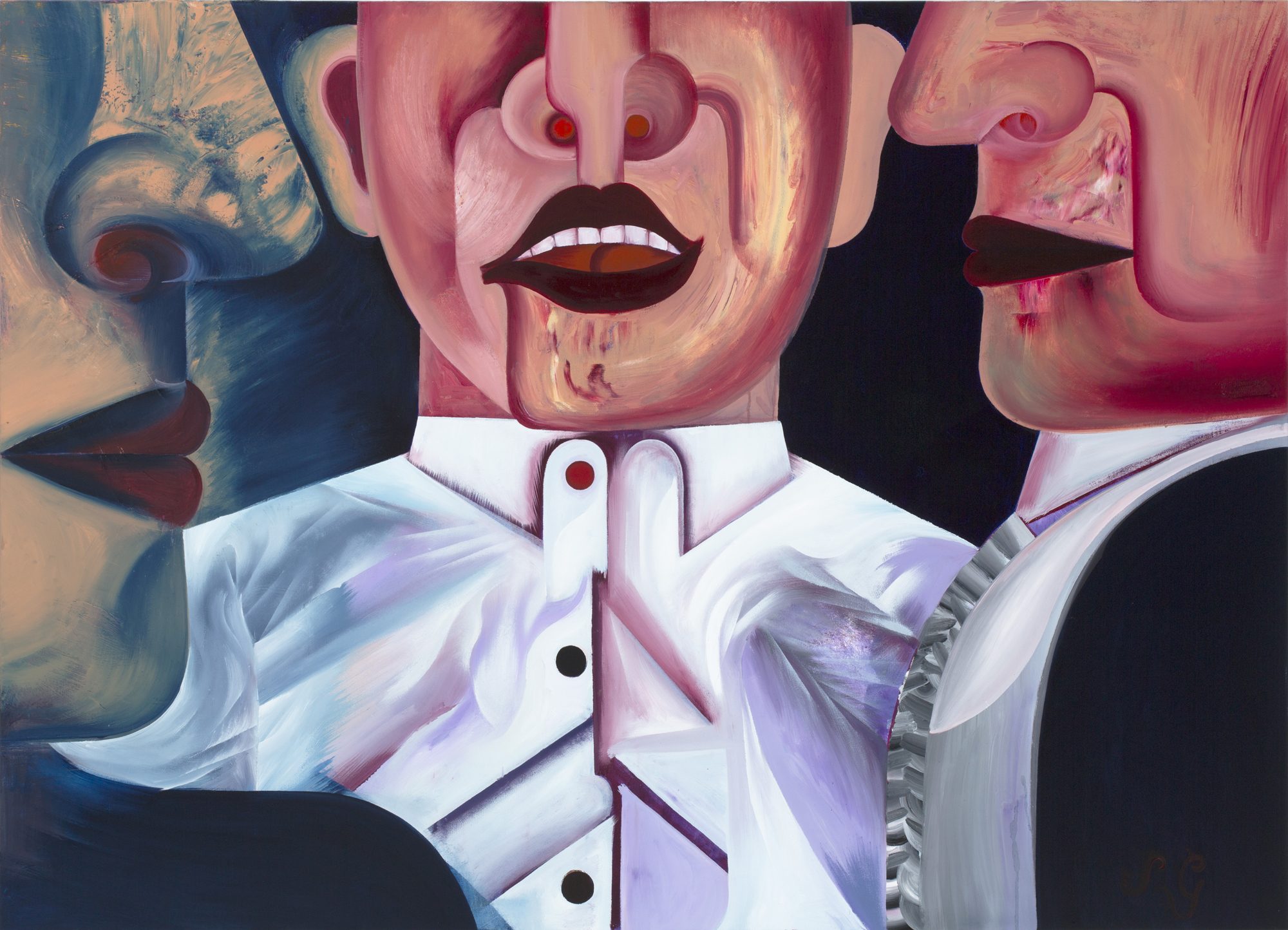
Sebastian Gögel, Connection, 2014

Address and Contact Information

Falkeplatz, 09112 Chemnitz
Mailing address and barrier-free access:
Stollberger Straße 2, 09119 Chemnitz
T +49 (0)371 488 7024, F +49 (0)371 488 7099
gunzenhauser@stadt-chemnitz.de

Opening hours

February to May 2026: Wed – Sun, public holidays 11 am – 6 pm
from June 2026: Tue – Sun, public holidays 11 am – 6 pm
closed 24./25./31.12.

Address and Contact Information

Falkeplatz, 09112 Chemnitz
Mailing address and barrier-free access:
Stollberger Straße 2, 09119 Chemnitz
T +49 (0)371 488 7024, F +49 (0)371 488 7099
gunzenhauser@stadt-chemnitz.de

Opening hours

February to May 2026: Wed – Sun, public holidays 11 am – 6 pm
from June 2026: Tue – Sun, public holidays 11 am – 6 pm
closed 24./25./31.12.

Sebastian Gögel in Dialogue with Works of Classic Modern Art from the Gunzenhauser Collection

This year’s summer exhibition in the Kunstsammlungen Chemnitz – Museum Gunzenhauser is dedicated to the representation of people in the work of artists of the collection in dialogue with a contemporary position. Under the title Sebastian Gögel. All too human (Allzumenschliches) paintings and graphics by Otto Dix, Conrad Felixmüller, Helmut Kolle, Gabriele Münter, Georg Schrimpf and others are merged with works by the artist Sebastian Gögel (*1978). Sometimes gloomy, sometimes humorous, but always with great seriousness and keen observation, they document the people of their time.

Sebastian Gögel directs his artist’s gaze to where it hurts — where tragedy and comedy meet. His paintings are reflections on social, political and societal injustices, which he illustrates using a distinctive pictorial idiom — yet without pointing a finger. Inherent in his timely gaze is a level-headedness that enables him to depict the persons in his portraits, while also creating a de-individualised form of them: the lawyer, friends, the dreamer or the child. Compositionally, however, his seemingly stereotypical bodies rendered in dense colours threaten to fall apart at any moment. The sense organs are often depicted as inhumanly machine- or animal-like, and evoke tense moments which are now aggressive, now ecstatic. In a foreboding mood of new departure or else locked into self-made constructions, they represent, from face to face, symbols of interhuman relations. Whereas artists in the Weimar Republic turned away from the ecstasies of Expressionism, cultivated a sober, New Objectivity view of things, and devoted themselves with delight and curiosity to all facets of human existence, Gögel’s works can be read as a symbiosis of both tendencies. In an expressionistic manner and with a great hunger for matter, surface and colour, he exposes the verism of his motifs layer by layer. Seeing becomes an inward gaze — and a shuddering in the face of what can appear beneath.

Sebastian Gögel was born in 1978 in Sonneberg. From 1997 to 2005 he studied painting at the University of Graphic Art and Book Art in Leipzig, where he completed his master’s degree with Professor Sighard Gille in 2005. The artist’s world of colors, shapes and figures cannot be restricted to a fixed medium, nor does his artistic vocabulary know any visible limits. Not only in his work as a painter but also as a graphic artist, sculptor, photographer and tattoo artist, Gögels works get under your skin. Sebastian Gögel lives and works in Leipzig.

Gallery

The houses of the Kunstsammlungen Chemnitz

Museum Gunzenhauser, Foto: Kunstsammlungen Chemnitz/PUNCTUM/Bertram Kober

Museum Gunzenhauser

The Museum Gunzenhauser houses the collection of the Munich gallery owner Dr. Alfred Gunzenhauser and holds more than 3,000 works by 270 artists, including works of classic modern art and from the second half of the 20th century. The owner is the Gunzenhauser Foundation.

Learn More
  • Admission

    General admission 10 Euros, reduced admission 6,50 Euros

    For children and adolescents through age 17, as well as for students of the Technical University Chemnitz, holders of a Chemnitzpass, and chaperones to severely handicapped persons, admission is always free.
    For further information regarding individual and group admission fees and combination tickets valid for more than one of the museums within the Kunstsammlungen Chemnitz, please see the schedule of fees (Entgeltordnung).

    Tickets
  • Combination Ticket – Art Collections at Theaterplatz and Gunzenhauser Museum

    From November 4, 2025: general admission 18 euros, reduced admission 12 euros

    Tickets
  • Combination Ticket – All Museums Including Rabenstein Castle

    From November 4, 2025: general admission 28 euros, reduced admission 19 euros

    Tickets
  • Opening hours

    February to May 2026: Wed – Sun, public holidays 11 am – 6 pm
    from June 2026: Tue – Sun, public holidays 11 am – 6 pm
    closed 24./25./31.12.

  • Getting there

    Stollberger Straße 2, Chemnitz
    Getting there from Chemnitz Main Station: tram no. 4 (direction Hutholz) to the Falkeplatz/Museum Gunzenhauser stop

  • Barriere·Freiheit

    Der barrierefreie Eingang ist Stollberger Straße 2.
    Rollstuhl·Nutzer können alle Räume besuchen.

    Blinden·Hunde und Therapie·Hunde dürfen mit ins Museum.
    Für blinde Menschen gibt es einige Tast-Bilder.

You might also be interested in

Presentation of the Collection

Gothic Sculpture in Saxony

Presentation of the Collection

Romanticism and Modernism

01.05.2026 – 01.11.2026

The History of the Great Hall

29.05.2026 – 04.10.2026

An Unfinished Story

Die Kunstsammlung von Lola und David Leder in Chemnitz

26.06.2026 – 20.09.2026

Verlassene und verschwundene Bauwerke in Chemnitz Fotografien von Christian Sünderwald

04.07.2026 – 01.11.2026

03.10.2026 – 11.04.2027

Allegorien des Lebens (Allegories of Life)

Ursula Mattheuer-Neustädt und Wolfgang Mattheuer

03.10.2026 – 21.02.2027

Mythos (Myth)

Von Göttern zu Superheldinnen